
Honda Zoomer parts are almost always custom parts. Very few people buy for a Zoomer to keep it standard, and the range we built up reflects that: front end conversions, frame and seat parts, wheels, exhausts and the drive components that go with a rebuilt bike.
The brands behind our Honda Zoomer parts
The Zoomer range was assembled from the Japanese aftermarket rather than from one supplier. The brands we listed for it were NCY, Kijima, Daytona, Takegawa, Kitaco, Hurricane and BMF, with Zoomania parts alongside them for specific jobs. Goodridge supplied the braided brake line and banjos, and a Nisshin master cylinder kit appeared on some builds in place of the Daytona one.
Those names matter when you order, because they are not interchangeable. A holder made for one company’s caliper will not carry another’s, and a kit assembled around one brand’s fork expects that brand’s collars and cables. Tell us which direction you are building in and we will keep the parts consistent.
Front fork, disc brake and wheel kits
The biggest single thing we supplied for the Zoomer was the front end conversion, sold as a kit rather than as loose parts. The standard build was based on genuine Honda Dio-ZX forks and wheels with the matching caliper and pad set, disc and bolts and speedometer gear, then a Daytona master cylinder and lever kit, a Daytona wheel collar kit, a long speedometer cable and a braided brake line with banjos.
The Dio-ZX components in that kit are ordered as genuine Honda parts, against Honda part numbers, which is worth knowing because it means the core of the conversion comes through the factory system rather than the accessory trade.
It was listed in seven versions. Dio forks and wheels in gold; the same in black; KN forks in silver, red, blue or gold with gold Dio wheels; a KN carbon fork kit with gold Dio wheels; the carbon kit again with black Dio wheels; a BMF kit; and a Daytona kit built on 12 inch tubeless aluminium wheels.
Options ran on top of that. Dio forks and wheels could be taken separately in black, KN forks separately in carbon or in the plain colours, and KN forks were also listed in a version lowered by 30 mm. A Daytona Braking wavy disc came in 160 mm and 190 mm, the larger one needing a Kitaco caliper holder to mount it. Zoomania supplied a speedometer gear cut for a 120/90-10 rear tyre, so if you are fitting a wider tyre than standard, say so when you ask — it changes which gear you want.
Frame, seat and bodywork
The Daytona body range covered most of what people do to a Zoomer frame. A subframe was listed with aluminium steps or without them; an FRP fuel tank cover that only works once that subframe is fitted; a low-down seat frame; an aluminium panel; a short rear fender; a short side stand.
Cockpit parts went with them: a handlebar clamp kit, a drag bar of 600 mm, a throttle housing, soft grips, custom mirrors, a mechanical speedometer, a separate mirror stay that is only needed if you fit that speedometer, small indicators with their bolts and earth leads, a braided rear brake cable and a chrome cable coil. The drag bar is the one that catches people out: at that width the standard brake hose is short, and a build using it wants roughly 750 mm of hose.
Front disc hub and rear drum hub kits finished the job at both ends, with tubeless wide aluminium wheels in 12 inch, 2.75 at the front and 4.00 at the rear, each offered plain, in an eight-hole pattern or in a five-spoke pattern. The indicators are ordered in pairs, and so are their bolts and earth leads, which is the sort of thing worth confirming in the quotation rather than discovering on the bench.
Exhaust, air cleaner and drive parts
Exhausts were a category of their own, including a stainless drag muffler. On the intake side there was a custom air cleaner kit made to work with the standard carburettor, finished in blue or chrome.
For the transmission, a power pulley kit and a strengthened V-belt were listed together, which is the sensible way to buy them: the pulley kit changes how the variator behaves and the belt is the part that takes the consequence. A racing CDI and a dipstick oil temperature gauge round out the engine side. None of this is factory equipment, so it is worth telling us what has already been done to the bike before you add to it.
What this page cannot tell you
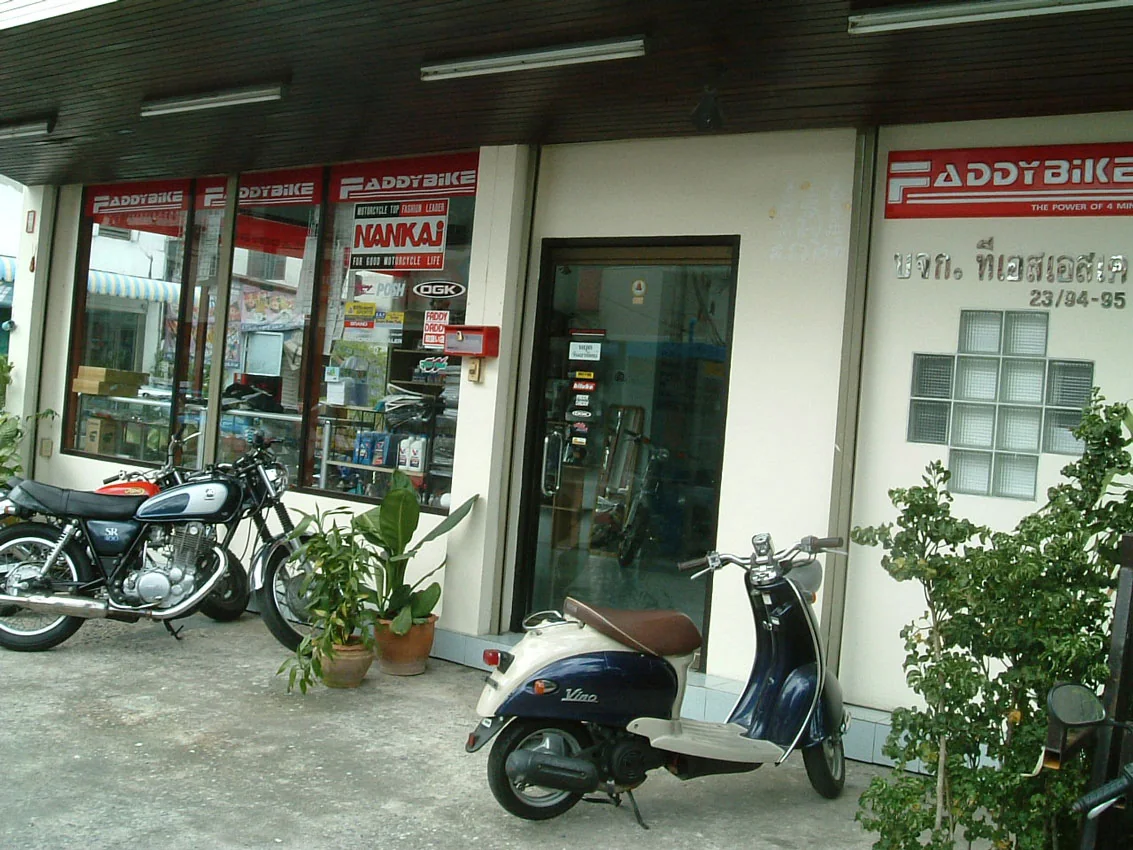
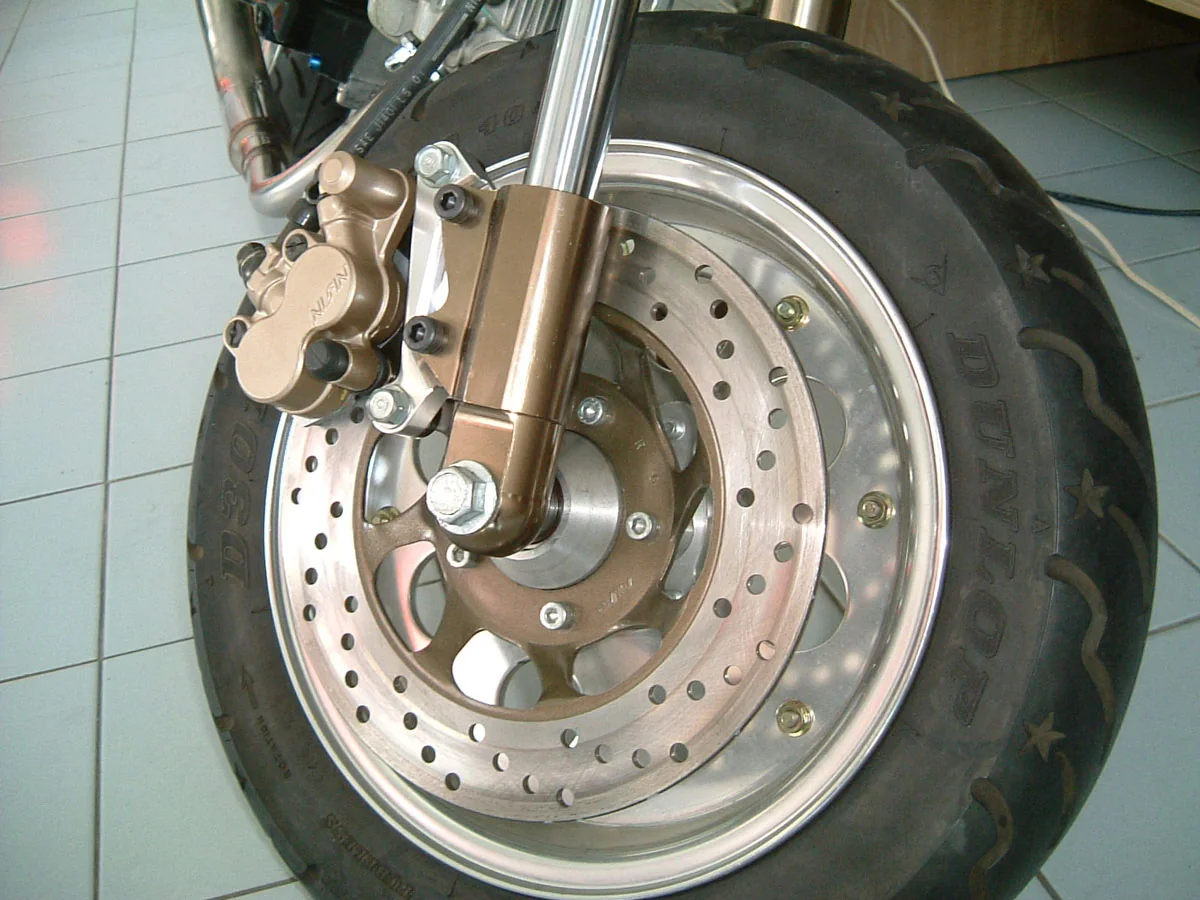
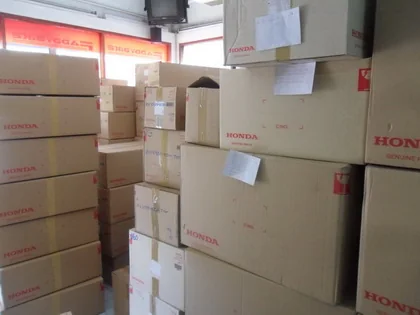
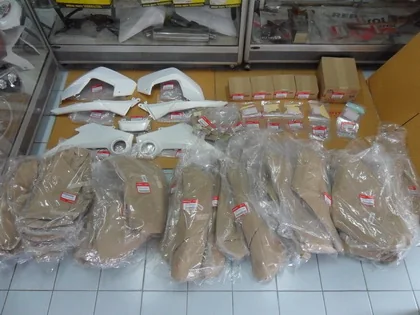
Two things. The first is what the machine looks like. Nothing in our own archive shows a Zoomer in a picture we are free to publish, so the photographs here are of the shop, the shelves and the packing bench. None of them is a Zoomer, and each caption says so, because a picture of a different scooter would be an error rather than decoration.
The second is stock. What is written above is the shape of the range we supplied, not a live shelf count. Some of these parts have been out of production for years and some are still ordered without difficulty. The only honest way to find out which is which is to ask us about the specific part.
Ordering and shipping from Bangkok
Every order starts as an email. You tell us what you are trying to build, we check the supply source in Thailand or in Japan, and we come back with availability and a price in Thai Baht. Kits are quoted as kits; if you already own half of one, say so and we will quote the remainder. The order policy sets out payment, packing and returns.
Payment is by bank transfer, by credit card through a secure link, or by PayPal, and a CIF figure is the parts price with shipping added. Once an order has shipped we cannot take it back except where there is a manufacturer’s fault, and nothing can be returned to Thailand at all. On a bike built out of parts from seven different makers that is the argument for describing the whole build in the first email rather than ordering piece by piece.
Genuine Honda components ordered through Japan are normally available in about four working days if they are not backordered, and parts from Japan explains how that supply runs. Postal EMS is four to seven days; air parcel is about two weeks where EMS does not reach. Wheels, forks and frame parts are bulky, so those often go by courier or air cargo instead, and duties are charged on arrival in your country.
Ask for a quotation
Send the part number if you have one, or the part name together with your frame number, and tell us the destination country and how many you need. Say which fork kit and which wheel size you are working towards, and add a photograph of the bike as it stands — that helps more on a Zoomer than on most machines.
Request a quote for Zoomer parts, or open one with braking, bodywork or drivetrain already selected. See what else we cover through shop by model.