
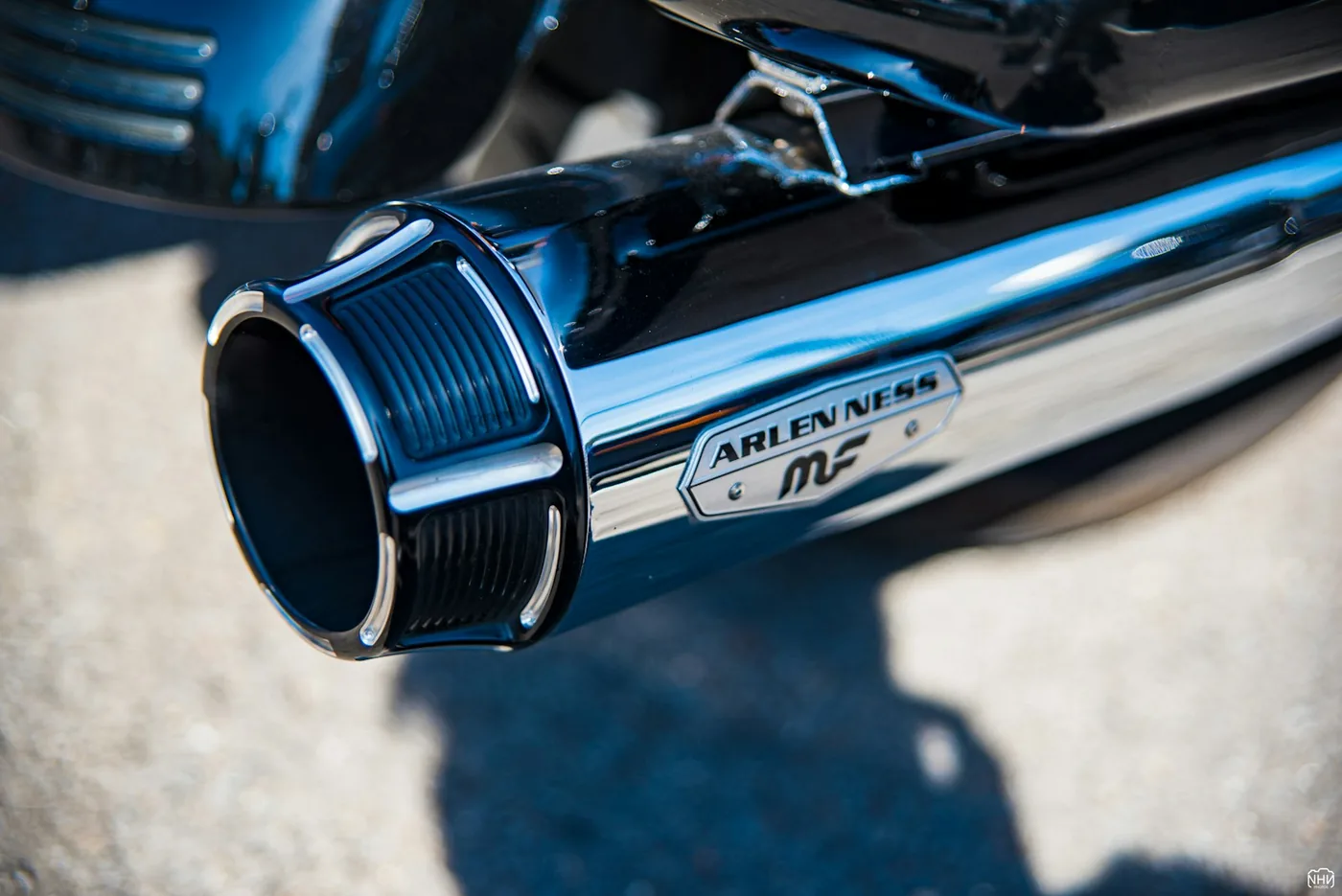
The oldest page in this shop’s archive is a table of Over Racing parts captured in February 2001, and it lists a shape, a finish, a code and three measurements. It names no motorcycle anywhere.
The oldest page in our archive lists no machine at all
The page is titled with nothing but the brand name: black background, a row of header images, one table. Nothing else in our archive reaches back that far, and the next oldest brand page is eight years younger.
The header row runs: type, colour, number, three columns headed A, B and C, then a price in yen. Ten rows sit beneath it, covering seven silhouette families in a handful of finishes. That is the whole of it.
What is missing is the thing every other page on this site begins from. No model, no year, no displacement, no market. Our directory of Japanese motorcycle parts brands files this maker under exhaust and chassis, which is as far as a directory goes; this page is about a listing organised by geometry instead of by machine.
A category chosen by shape
The families are printed as Tracker, One-Letter Shot, Konchi Shot, Semi Up Shot, Flat, Semi Up and NK Touring, the last two also in an aluminium version. Those are Japanese shop names for outlines. We will not translate them or say what any of them is meant to look like, because nothing we can point to defines them.
The finishes recorded against those shapes are black, nickel, silver, light gold and stainless, with grey, blue, light gold and red on the aluminium versions. Each finish carried a code of its own rather than being an option against one code, a pattern our motorcycle rearsets page has already described.
One caution before you go further: more than one operation trades under this name in different countries, and we assert no relationship between them. The wider exhaust conversation lives on our motorcycle exhaust parts page and is not repeated here.
What you have to go on, and what it settles
People write about this brand holding one piece of evidence and wanting to know what it proves. Here are the usual ones.
| What you have to go on | What that actually settles | What it leaves wide open | What we need from you |
|---|---|---|---|
| A silhouette name off an old listing | The shape family, and nothing else | Which machine it was ever made to fit | The machine you want it on, and photographs of where it has to run |
| A photograph of a silencer on somebody’s bike | Roughly what shape you are after | Maker, age, material, and whether it is that maker’s at all | Close photographs of every band, stamp, plate and weld |
| An item in your hands with markings on it | A starting point we can search from | Whether the marking is a maker’s code or a shop’s own row number | The markings exactly as printed, and the machine |
| The word “stainless” and nothing more | That it is not plated steel | Which stainless, and how it behaves where you ride | What the bike is for, and the climate it lives in |
| A finish you would like it in | What you are asking us to look for | Whether that finish was ever made in that shape | The shape and the finish together, plus the machine |
| Measurements you have taken yourself | The space the part has to fit into | What our own record measured, because it never said | The measurements, and a photograph showing where you took them |
The middle two columns are the ones a catalogue never prints. The last row is the argument of this page in miniature.
Our own record of Over Racing parts is not enough to order from
Three columns in that table are headed A, B and C, and nowhere does the page say what they measure. No key, no diagram, no note. We are not going to work it out for you from the numbers.
One structural thing can be said without guessing. The figures are identical across every finish inside a family, and the aluminium version of a family carries the same figures as its plated counterpart. Whatever A, B and C are, they belong to the silhouette rather than to the finish.
That is as far as our record goes, and not far enough to order from. A shop dressing three unlabelled numbers up as specifications would be selling confidence rather than information. Your own measurements, taken off your own machine, are better evidence than anything on that page.
Stainless is a family, not a material
One of the finishes in the archived table is a single word, misspelled, with no grade beside it. That word is doing a great deal of work and carrying very little information.
Stainless is not one material. The Australian Stainless Steel Development Association publishes guidance on the traps to avoid when fabricating stainless steel, and the grade families it sets out — austenitic, ferritic, duplex, and the steps between common grades — are chosen for the conditions a part will live in. It also describes the aim of putting finished work into service in a passive condition, free of corrosive reaction, and how grinding and machining disturb that surface until the film re-forms.
So stainless is a family whose members do not behave alike. We will not tell you what grade any silencer is, because nothing in our record says, nor how one will weather where you live. We would rather put that back to you than let one word stand in for an answer.
Questions we are asked about this listing
What do A, B and C mean on your old page?
We do not know, and we will not guess. The columns are unlabelled in the original and there is no key anywhere on it. If you need dimensions, the ones worth having are the ones you take yourself.
Can you tell me whether one of these will fit my bike?
Not from a shape name. A silhouette family describes an outline, and the archived table never tied one to a machine. Send the machine and its frame number, photographs of where the part has to run, and the measurements of the space it has to occupy.
I own one and cannot identify it. Can you?
Possibly not, and we would rather say so first. Photograph every band, stamp, plate, weld and rivet in good light, and we will tell you what we can read and what we cannot. We will not assert a maker for an unmarked item. Our notes on identifying motorcycle parts from photographs cover how to send them.
Do you still list these?
What is described here is a record of what this shop once listed, from a page a quarter of a century old. Treat it as history rather than as a shelf. Ask about the item rather than about the page, and we will check the supply source.
Asking us to price a shape you are after
Two things come first: the machine and its frame number, and what you want. That may be a shape name off the old listing, a photograph of one on somebody’s bike, or an item in your hands.
Then the evidence: photographs of the space the part has to occupy, the measurements you have taken, and a picture showing where you took them. If you own the part, photograph every marking rather than typing it from memory.
Add the destination country and the quantity, because prices from here are quoted in Thai Baht, CIF, with the shipping inside the figure. Send it through the engine and performance quotation form, and we will tell you by email what we can establish and what we cannot.