
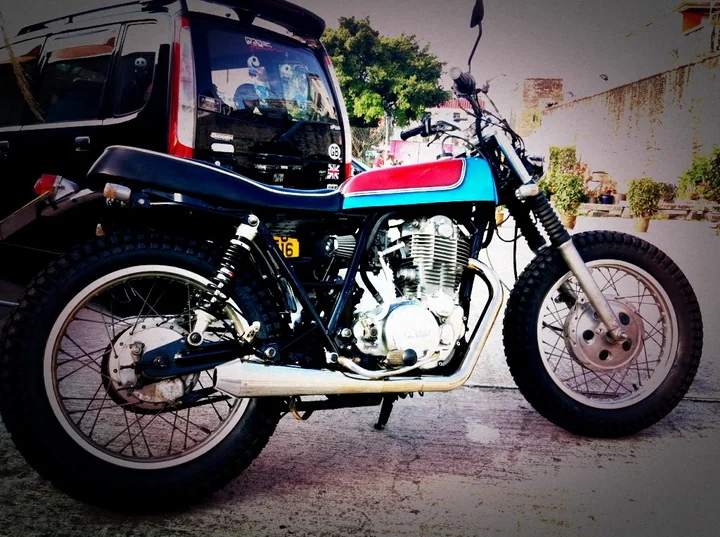
Yamaha SR400 parts sit on the classic-bike side of what we do, alongside the 4Mini work. Our SR listing was built up over years of supplying people who were rebuilding a single, restyling one, or simply trying to replace a rubber that had perished.
What the SR range covers
The SR was never one of those machines people leave standard. Most of what we were asked for fell into three groups, and most orders drew on more than one: parts that change how the bike looks, parts that change how it runs, and the small fittings that a bike of this age quietly loses.
That mix is why the listing runs long. It carries front and rear fenders, exhaust components, machined aluminium covers, swingarms, rims, handlebars, headlight and meter holders, a chain cover, cables, gaskets, brake shoes, lock rubbers and hand tools for the valve gear. We are a shop in Ladprao, Bangkok, not a catalogue, so the way to find out what is available now is to ask.
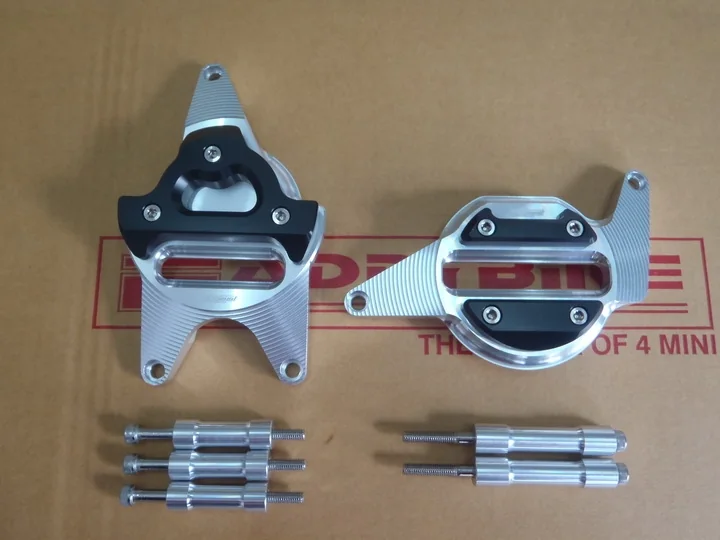
A good deal of it is machined from aluminium rather than cast, and the listing named the grades: AL7075 for the covers, bushes, top bridge bolts and sprockets, AL6061 for the stud bolt sets. These were made in small batches by a specialist rather than bought in as generic accessories, which is why some patterns come and go.
Café racer and tracker work
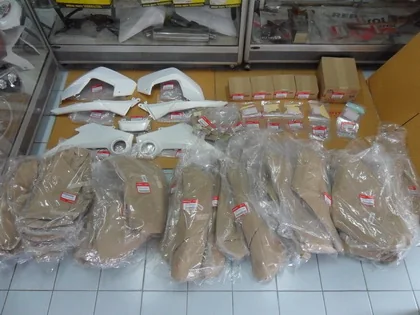
A large part of the SR trade is cosmetic, and it always has been. Front fenders were stocked in a café cut and a short tracker cut, and in a long profile as well, the long one measuring 510 by 110 mm. Rear fenders, rear fender locks and alloy caps went with them, along with a fibreglass tank cover shaped in the Norton style.
Above the fork there were top bridges, machined and cast, top bridge adjusters with or without the damper hole, top bridge bolts, fork top caps, a front fork adjuster and fork bolts. Headlight holders came in several fork diameters — the aluminium ones were listed at 35, 36, 37 and 39 mm — with headlight bushes in silver or black and steering damper holders to suit. Below that: standard and oversized fork covers, dust protectors and dust rubbers, foot pegs and rubbers, grips, handlebars, meter and indicator holders, indicator lenses in orange or clear, an LED tail light, rear grips and side bag locks.
Alloy swingarms were stocked in more than one pattern — a second and a third design, including a polished version — with aluminium rims, alloy sprockets and an aluminium front sprocket cover. The rims were listed as two sets: a 17 inch pair in 2.50 and 3.50, and an 18 inch pair in 1.85 and 2.15. Sprockets came for 428 chain and for 520, which is the first thing to settle if you are changing gearing.
Exhaust, covers and machined parts
For the exhaust there were curved and straight pipes to work with the standard silencer, megaphones in a long and a short length, a megaphone exhaust, a stainless system, a standard manifold and an end cap for a SuperTrapp-style silencer.
Around the engine the listing is mostly machined aluminium: valve setting covers, oil filter covers and caps, rotor covers, a camshaft marking cover, a valve lifter cover, cam chain setting nuts including one with a clear lens, a decompression starter cover, oil level gauges in silver and black, an oil tank cover, oil hose and hose adapters, an eccentric crankshaft bolt, stud bolts, an engine protector and an engine holder. There is also an air horn for an FCR carburettor for people who have gone that way.
Yamaha SR400 parts that wear out
The unglamorous half of the listing is the half most people actually email about. Cables for the speedometer, tachometer, clutch, brake and valve lifter. Clutch cover and rotor cover gaskets. Rear brake shoes and a rear brake lever. Swingarm bushes and seals. Steering ball assemblies. Seat lock, tank lock and kick arm rubbers. Gear arm levers, key lock plates, tank stoppers, battery trays, an under-seat wire harness tray, drum brake locks front and rear, and drum brake hub caps.
Two hand tools were stocked alongside them, a valve puller and a valve lifter lever, which tells you something about who was buying.
Shared with the SR500 and the XS650
Our SR listing was written as one range for the SR400 and the SR500, because outside the engine the two machines are close enough that the same fender, the same top bridge and the same swingarm suit either. Where a part is split it is usually by production period rather than by capacity, so an early bike and a late one can need different versions of the same item. Tell us which you have.
The listing was explicit about where those lines fall. Steering ball assemblies were listed in a 1978 to 2000 version and a 2001 to 2008 version. Top bridge bolts were split the same way: one for the 1978 to 2000 machines, shared with the XS650, and one for the later bikes. If you know the year of yours, that alone answers most of the questions we would otherwise have to ask.
A number of the fork and steering parts also fit the XS650, and the same classic listing reached beyond Yamaha altogether. It carried valve setting bolts, aluminium clutch and rotor covers, a front fender and a top bridge adjuster for the CB750; front fenders in standard and short tracker cuts for the Clubman 400 and CB400SS; parts for the Kawasaki TR250; front fenders for the Suzuki Tempter 400 and Volty 250; and fenders for the Kawasaki W650. If you are working on one of those, ask anyway.
Ordering and shipping from Bangkok
Nothing here is sold from a live catalogue. You tell us the machine and the part, we check the supply source in Thailand or in Japan, and we come back by email with availability and a price in Thai Baht. A part number, if you have one, makes that quick. Without one, the part name together with your frame number is the next best thing, and a photograph of the part or of where it fits often settles an identification faster than any description. The order policy sets out the rest.
Once you accept a quotation, payment is by bank transfer, by credit card through a secure link, or by PayPal. A CIF figure is the parts price with the shipping added. Orders are packed at our own premises, which matters on a fender or a polished swingarm more than it does on a gasket.
Genuine parts ordered from Japan are normally available in about four working days if the factory is not backordered, and parts from Japan explains how that side of the supply works. Postal EMS runs four to seven days; air parcel is about two weeks where EMS does not reach. Bulky items go by courier or air cargo, and import duties are charged when the package lands in your country. We cannot accept a return once an order has shipped except for a manufacturer’s fault, so settle the year of the bike and the fork diameter before you confirm.
Ask for a quotation
Send the part number, or the part name with your frame number, plus the destination country and how many you need. A photograph helps. We reply by email with availability and a price.
Request a quote for SR parts, or open one with bodywork or suspension already selected. Browse the rest of the range through shop by model. There is no account to create and no obligation; a quotation is just an email.