
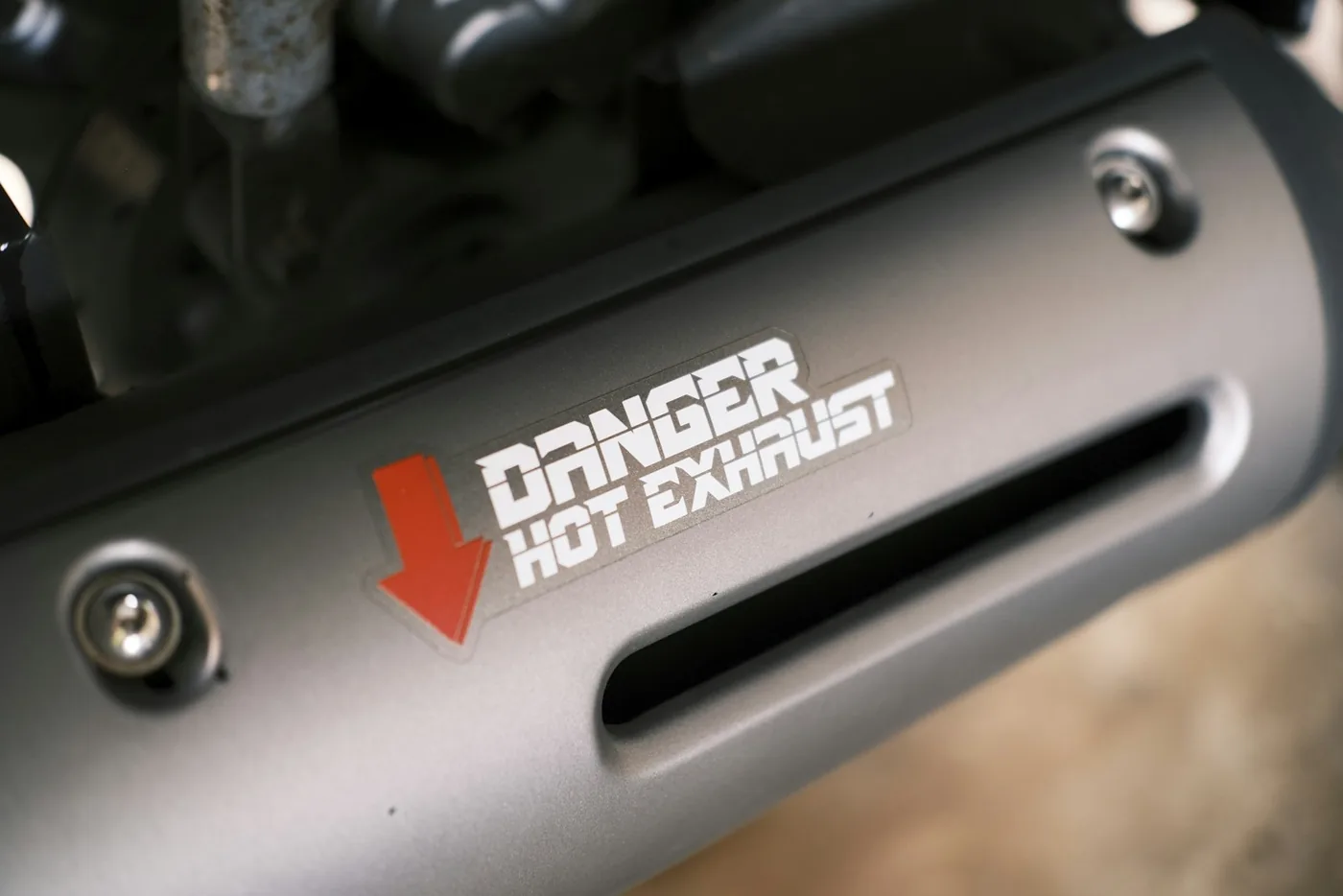
Motorcycle exhaust parts and motorcycle exhaust systems are two different enquiries, and the search term collapses them into one. Most people who write to us about an exhaust already have the pipe; what they are short of is a bracket, a collar, a gasket or a mounting rubber.
Usually it is the piece you are missing, not the pipe
The typical message describes a job that has stopped. A hanger has cracked on a Wave125 somewhere in Europe, a collar has come apart on a KSR110, or a gasket has burned out and the pipe will not go back on without one. None of those items has a local route to the owner, because the machine was never sold there.
That is what an email-quote shop is good at, and the large exhaust retailers online serve it badly. Their catalogues are built around choosing a system, not around finding the small item that holds one in place. Our parts index covers the categories in the ordinary way; this page is for the fulfilment problem underneath. Where a job opens several seals at once, gasket sets is the better page.
What you are actually ordering when you order an exhaust part
The table sorts the enquiry rather than the product: what each kind of order consists of, what goes alongside it, and what we need to price it. It is not a fitment chart and claims nothing about what exists for a given machine.
| You are ordering | What it is | Order with it | We need |
|---|---|---|---|
| Slip-on silencer | The rear section only, joining the standard front pipe | Joint clamp, often a fresh mounting rubber | Frame number, and whether the standard front pipe is still fitted |
| Full system | Front pipe and silencer as one product | Exhaust gasket, sometimes a different mount | Frame number, and whether a catalytic converter is fitted |
| Header or downpipe alone | The front section between engine and silencer | Exhaust gasket, flange, collar | Frame number; front pipes are model-specific |
| Exhaust and manifold gaskets | The seal at each end of the run | Order them with the pipe | Machine, and how many joints you are opening |
| Mounts, hangers, clamps, collars | Hardware holding the system on | Nothing | A photograph of the broken item |
| Genuine replacement exhaust | The item the factory listed | Gaskets | Frame number, and the market it was sold in |
Every row ends in something you can put in a message, which is the only reason it is here. An enquiry naming the machine and the row is quotable; one asking the price of an exhaust is not.
The makers this range has been built from
The small-capacity exhaust trade is Japanese and Thai, transacted on Japanese and Thai shop sites, and close to invisible in English. That is why searching in English returns nothing for a small commuter machine while a substantial industry exists for it.
Our own archive records which makers have been supplied against which machines.
- Monkey and Dax: Mizumoto Racing, and Heat-Magic in titanium.
- CBR150R, Wave125 and Sonic: NMF Racing, Endurance and DBS, including a carbon version.
- KSR110: Proskill, Outex and KRS.
- SR400 and SR500: a stainless system and a megaphone.
Those are records of what has been supplied, not a stock list, and none should be read as a statement of what can be obtained today.
The better-known Japanese exhaust names are described on our brands page and there is no sense in repeating that here. If you already know the maker you want, name it in the enquiry along with the machine.
Slip-on, full system, or the front pipe by itself
On a large road motorcycle this is largely a question of taste and budget. On a small machine it is a fitment question first. The front pipe, its mount and its gasket are made for a particular model, and the joint a slip-on meets is only standard while the standard front pipe is in place.
Two things follow. If another maker’s front section has already been fitted, a slip-on chosen from a catalogue may not meet it, and headers from different makers do not reliably interchange with standard ones. On a machine built with a catalytic converter the standard front section is not necessarily a clean joint either, so tell us whether one is fitted.
An exhaust change is rarely made alone. It usually sits alongside intake and camshaft decisions, and what a pipe does to a power curve belongs with engine parts.
What a JMCA plate means, and why some systems exist twice
Buyers outside Japan regularly ask about the small certification plate riveted to a Japanese aftermarket silencer. It is worth understanding, because people who have not met it before either over-value it or ignore it.
JMCA, the Japanese trade association for motorcycle accessories, operates a certification and testing scheme for aftermarket mufflers. Its own material describes that scheme as covering two regulatory areas: motorcycle exhaust emission regulation, and noise regulation values including the proximity exhaust noise measurement. A plate is evidence the system has been through the association’s testing for road use in Japan.
It is not evidence of anything in your country. We do not tell you whether a system is legal where you ride, and we publish no noise figures. The point for an order is different: it is why several Japanese makers list a certified road version and a competition version of what looks like one product.
Motorcycle exhaust parts: questions from buyers abroad
Can you supply just a bracket or a collar rather than a whole system?
That is the most common exhaust enquiry we get and it is a normal order. Photograph the broken item next to something for scale, photograph where it mounts, and send the frame number. Small hardware is where a written description goes wrong and a picture settles it.
Will a system made for the current 125 fit an older machine with the same name?
Assume not, and do not order on the strength of the name matching. The recent 125s are separate machines with their own mounting arrangements, and we publish no claim that anything crosses between them. Send the frame number and we will check rather than estimate.
Is a Japanese certified system road legal where I live?
We have no way of answering that and would be wrong to try. Certification schemes are national, the JMCA scheme is Japanese, and the rules where you ride are for you or your inspection authority to establish. What we can tell you is which version of a product a maker lists.
Sending us an exhaust enquiry
Tell us the machine and its frame number, or the part number if a fiche has given you one. Add whether the standard system is still on the bike, whether you want a slip-on, a full system or a single component, the destination country and the quantity. A photograph of what has failed, and of the joint it mates with, does more work than a paragraph of description.
All of that goes into the quote form under engine and performance, and we will look at what the source in Thailand or Japan can supply and reply by email with a price in Thai Baht. Quotations are CIF, so the figure covers the goods and the freight. Exhaust components cannot be returned to Thailand after shipment except for a manufacturer’s fault, which is why we ask for the frame number rather than the model name.