
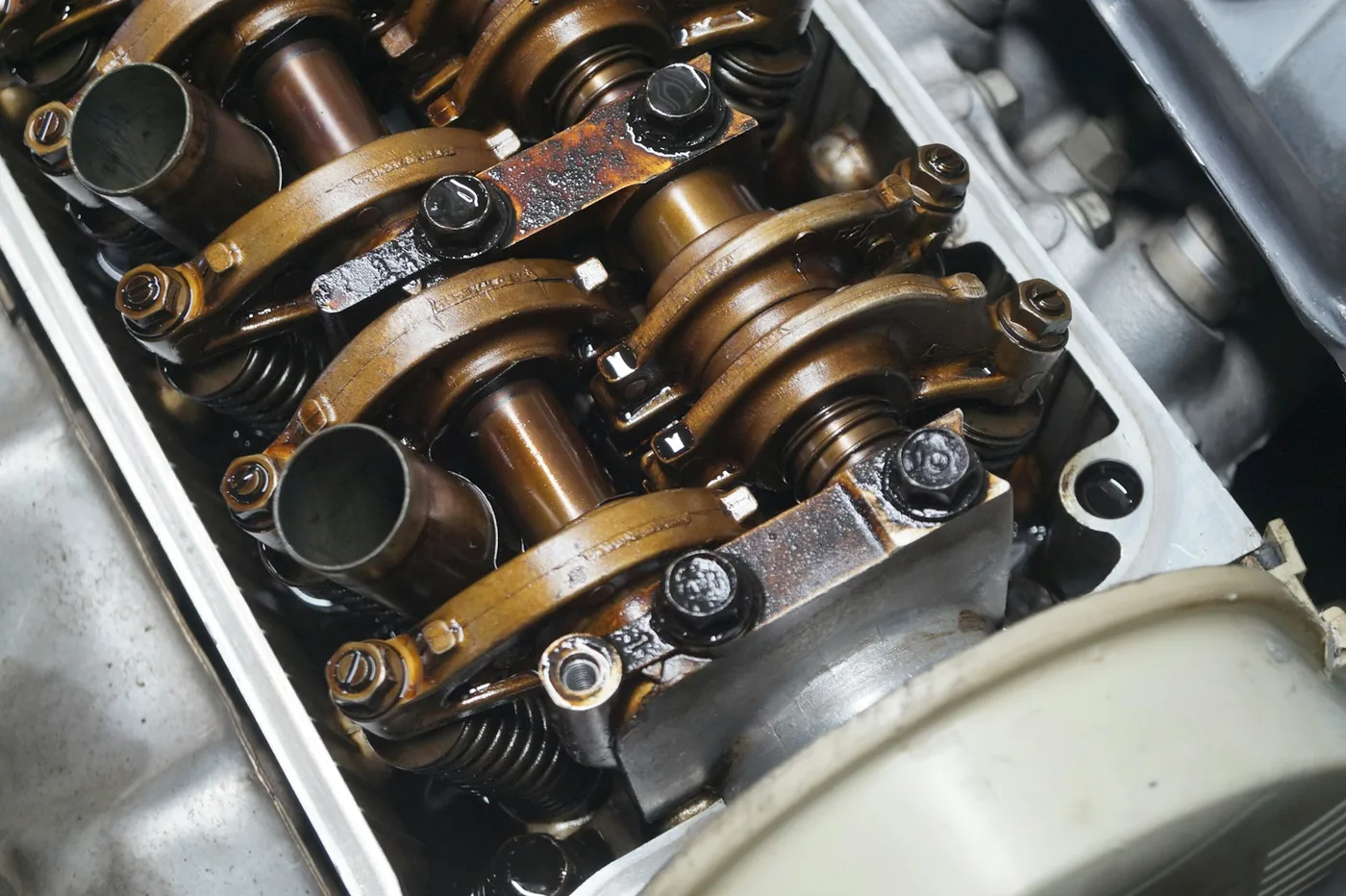
Motorcycle camshaft upgrades are researched as one purchase and almost never turn out to be one. On a small horizontal single the cam sits at the centre of a group of components that were designed to agree with each other, and changing it starts a short chain of consequences worth understanding before you spend anything.
Why motorcycle camshaft upgrades are never a single part
The question we are sent most often is not which cam, but some version of “anything else I should add”. That is the right instinct. A harder profile asks more of the valve springs, arrives at a different relationship with the piston crown, and changes what the engine wants through the carburettor.
Almost everything written in English about performance cams is written for large American twins, where a cam swap is a catalogued stage with a defined shopping list behind it. The engineering logic carries over; the parts do not. This page is about the horizontal single, and it sits under our main parts index alongside the other engine categories.
Which generation you have decides which cam exists
This is the piece no general guide covers, and it is the whole reason the page is worth reading. Three unrelated populations of engine answer to the same handful of model names, and the specialists who supply them catalogue their cams as separate products with no overlap.
Look at how a European specialist lists them and the split is plain. One camshaft is offered for six-volt Dax and Monkey machines. Another, from a different Japanese house, covers twelve-volt Dax along with the ZB, the CRF-derived engines, the Monkey R and the RT.
A third is listed against the current 125 generation, the JC92, JB03 and JB04 machines. The same nominal component, sold three times over, because the engines are not the same engine.
Our own archive shows the same division on the genuine side: the listing splits into a six-volt group and a twelve-volt group, and the six-volt machines take their own cables throughout. So the first thing we ask about a cam is never which cam. It is which engine, and the frame number is what answers that.
What a cam change drags with it
The table below is not a specification sheet. No lift, duration or timing figures appear on this site, because we have no source we could stand behind for them. What it sets out instead is the dependencies: change the thing in the first column and the second is what must be checked before the engine is closed up.
| What you change | What it forces you to check | Why | Where it comes from |
|---|---|---|---|
| Cam profile | Valve springs | A harder profile can outrun a standard spring | The Japanese tuning houses |
| Cam profile | Piston-to-valve clearance | Lift and compression are decided together, never separately | Japan, and some made in Thailand |
| Cam profile | Sprocket, chain and tensioner | Sold as their own sets here, and specific to a generation | Japan |
| Cam profile | Carburettor and jetting | The mixture has to follow the breathing | Japan or Thailand |
| Cylinder head | Which cams will fit at all | Tuning-house heads take their own cams | Japan |
| Displacement | Oil pump, clutch, gaskets and seals | The usual package around a bigger bore | Japan and Thailand |
| Engine generation | Everything above | The three families share no cams | Established from the frame number |
Three of those rows lead somewhere else on this site rather than being argued out here. Bore and compression belong with piston kits, sealing belongs with gasket sets, and the reason a tuned engine starts slipping belongs with clutch parts.
Staged kits, and why the Japanese houses sell systems
The tuning firms in Japan do not really sell camshafts. They sell stages, and the cam is one item inside a stage that also assumes a head, a piston and an intake. Names such as R-Stage, Super Head and STD-SPL are those makers’ own product naming, and you will meet them constantly once you start reading specialist listings for these engines.
The practical consequence is that buying one item out of a stage often disappoints. Those parts were developed against each other, so a cam dropped alone into a standard head behaves differently from what the catalogue photograph suggests. Where we can, we will say what an item is designed to sit alongside. The maker directory lives on our parts from Japan page.
There is no ECU to flash on most of these engines
Every guide that ranks for this subject ends the same way: retune the engine management afterwards. On a carburetted horizontal single there is nothing to retune electronically. The equivalent adjustment is mechanical, in the carburettor, and it is jetting.
That matters because a freer-breathing engine fed through a standard carburettor and standard jets does not just make less power than it should. It runs badly, in a way that feels like something is broken. If you are changing what the engine breathes, budget for the carburettor side in the same order.
Questions we get before quoting cam work
Can you tell me which camshaft suits my bike?
We can tell you what is catalogued for the engine generation your frame number places you in, and what it is normally sold alongside. We will not tell you that a particular cam fits a particular machine as a flat statement, because that is a fitment claim and this shop does not publish those. If the engine has already been modified, describe what is in it and the conversation gets far more useful.
Is a performance part allowed where I live?
That is your side of the transaction and it is worth checking before ordering rather than after. Countries do regulate aftermarket parts that affect a vehicle’s emissions: the United States Environmental Protection Agency, for instance, maintains what it calls its enforcement policy on vehicle and engine tampering and aftermarket defeat devices under the Clean Air Act. That is United States policy and we make no claim about its contents or about any other country. Duties, taxes and local rules on arrival are settled by the buyer.
Do you make any of this yourselves?
We make a small number of items for two models under our own name, described on those model pages. Engine internals for these machines mostly come out of Japan, and part of what we do is order from those houses directly from Bangkok, where we have traded since 2002. The counter knowledge is the service, not a catalogue.
What to send before we can price a camshaft
If you have taken a number off a fiche or off a maker’s listing, send that. Where you have not, name the item plainly, add the frame number, say which country the parcel is travelling to and how many you want. Pictures of the engine as it stands, particularly the head and the carburettor, save a great deal of correspondence.
It also helps to say what the finished bike is meant to do, because a machine built for short trips around town and a machine built to be revved hard want different answers. Send it through the quote form under engine and performance and we will find out what the Japanese or Thai supply side can actually do and come back by email in Thai Baht, CIF. Once a part has shipped it cannot come back to Thailand unless the fault is the manufacturer’s, so it is worth being thorough at this stage.