
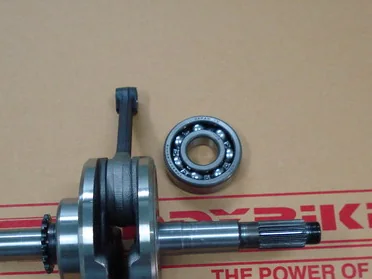
Honda Wave125 parts go to two quite different customers: someone keeping a daily underbone on the road, and someone building one to go quickly. We have supplied both from Ladprao, Bangkok since 2002, and the two ranges barely overlap.
Wave125, Innova125 — the same machine under two names
In Thailand it is the Wave125, in the carburettor and later the injected form. Exported, the same underbone is widely sold as the Innova125, and the injection model as the Innova125i. Owners in Europe in particular know the bike only by the Innova name and then cannot find anything listed under it.
If you tell us which name is on your bike and give us the frame number, we can work back to the Thai model and quote from there. That translation is a large part of what this page is for.
One more distinction is worth making at the same time: kick start or electric start. The two were built with different batteries and the electrical parts follow from that, so it is a question we will ask if you do not say. The same applies to the front end, since drum and disc bikes were both sold.
Honda Wave125 parts for a working bike
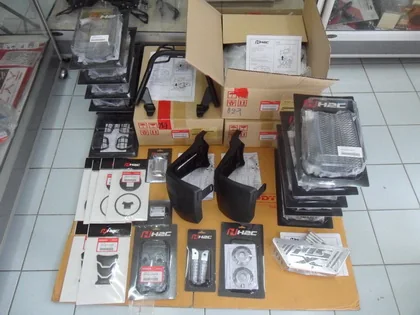
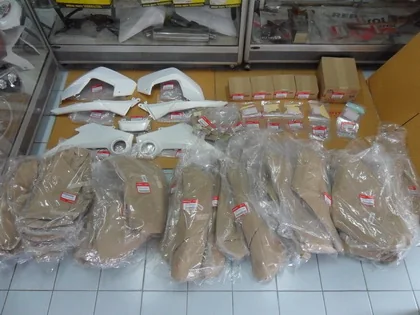
The everyday side is the less glamorous half and the one we are asked for most often from abroad. Genuine Honda components come through the factory parts system in Thailand or Japan: the consumables, the electrical parts, the panels and the small trim that wears out or gets broken.
Alongside those we have supplied the practical accessories a Wave carries in Thailand — front baskets and their hangers, carriers for a Givi top box, and chrome cover kits for owners who want the bike smartened up. It is worth remembering that a Wave in Thailand is a tool, and the parts range grew around that rather than around show bikes.
Tune-up parts for the small Honda four-stroke
The tuning range for these engines is deep, because Thai racing has worked on them for decades. What we listed for the Wave and its close relatives, the Wave110 and Nice110, runs from mild to serious.
- Racing camshafts, big valves and racing crankshafts in more than one stroke length.
- Pistons across a wide range of bores in flat and high-compression forms, in several gudgeon-pin sizes, and big-bore cylinder kits.
- Racing transmission gear sets in several ratio combinations, gearshift drums with a one-down three-up pattern, and conversion covers for a hand clutch on a machine that left the factory without one.
- Clutch assemblies including a four-spring type, racing plates, friction discs and stronger springs.
- Keihin flat-slide carburettors with the matching inlet manifolds in more than one size.
- Racing chain and sprockets in 415 pitch, and drive and rear sprockets for the standard chain.
None of that is a shopping list to work through in order. Tell us what the bike is for — commuting with a bit more urge, sprint racing, or a full build — and we will tell you which parts belong together and which combinations we have supplied before.
Bottom-end and cylinder-head work
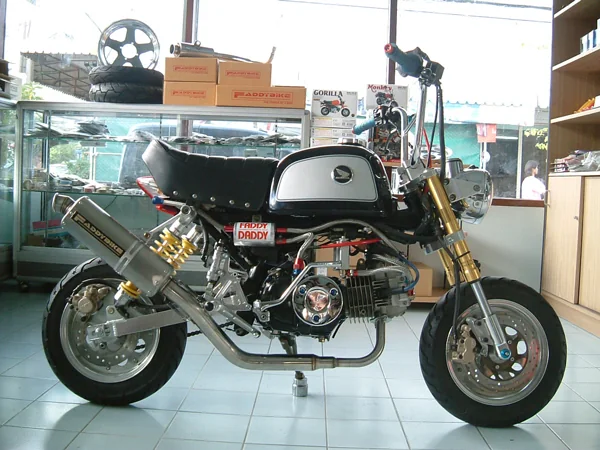
Most serious Wave builds run out of engine before they run out of ideas, and the order in which the work is done decides what it costs. A big-bore kit on its own is a modest change; the same kit behind a bigger carburettor, a racing cam and valves sized to suit is a different engine.
The parts to think about together are the crankshaft, the piston and its pin, the cylinder and head, the valves and the camshaft. Bores and strokes were listed across a wide span, so tell us what the crankcases have already had done to them — a machine bought second-hand in Thailand may already be bored, and fitting a kit to it blind is how people end up with an engine that will not go together.
Exhausts, ignition and chassis
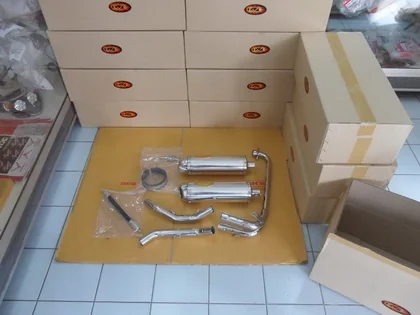
On the exhaust side we have supplied racing systems and pipes from the Thai makers, NMF and Endurance among them. Ignition is the other common first step: racing CDI units from API Racing, NMF and X-Box were all part of the range, and the right one depends on which engine specification the bike is now in rather than on which is newest.
For the chassis there are upside-down fork kits, replacement swingarms, rear shock absorbers and aluminium rearsets. These change the geometry and the ergonomics of the bike, so tell us what wheels and brakes you are running before we quote — a fork kit that suits one front end will not suit another.
How ordering works
There is no live catalogue and nothing is sold from a shopping cart. You send an enquiry describing the machine and the part, we check the supply source in Thailand or in Japan, and we reply by email with availability and a price in Thai Baht. Payment is by bank transfer, credit card through a secure link, or PayPal.
Send a part number if you have one. If you do not, the part name with your frame number is the next best thing, and a photograph of the part or of where it fits is better than a paragraph of description. Genuine parts ordered from Japan are normally available in about four working days when the factory is not backordered. The order policy covers the whole sequence, including the rule that we cannot take a part back after it has shipped except for a manufacturer’s fault.
Because the Wave is a common machine, quantity comes up more often here than on the older models. If you are a shop ordering several sets of the same item, say so in the first email — it changes how we buy the parts in.
Getting the parcel to you
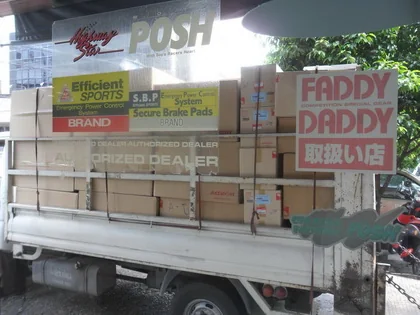
Orders are packed at our own premises in Bangkok. Postal EMS from Thailand or Japan runs about four to seven days; postal air parcel takes roughly two weeks where EMS does not reach. Forks, swingarms and exhaust systems usually go by courier or air cargo instead. Shipping is priced into the quotation, and import duty and tax are charged in your own country and are yours to pay.
Customs treatment of engine parts varies more than people expect, so if you are ordering a crankshaft or a cylinder kit it is worth asking your own customs office what they will want to see before the parcel arrives rather than after.
Ask for a quotation
Send the part number, or the part name with your frame number, and tell us the destination country and the quantity. Say whether the bike is a Wave125 or an Innova125 and whether it is carburettor or injection, because that decides half of the answer.
Request a quote for Wave125 parts, or open one with engine and performance, drivetrain or accessories already selected. The model index lists the other machines we supply.